


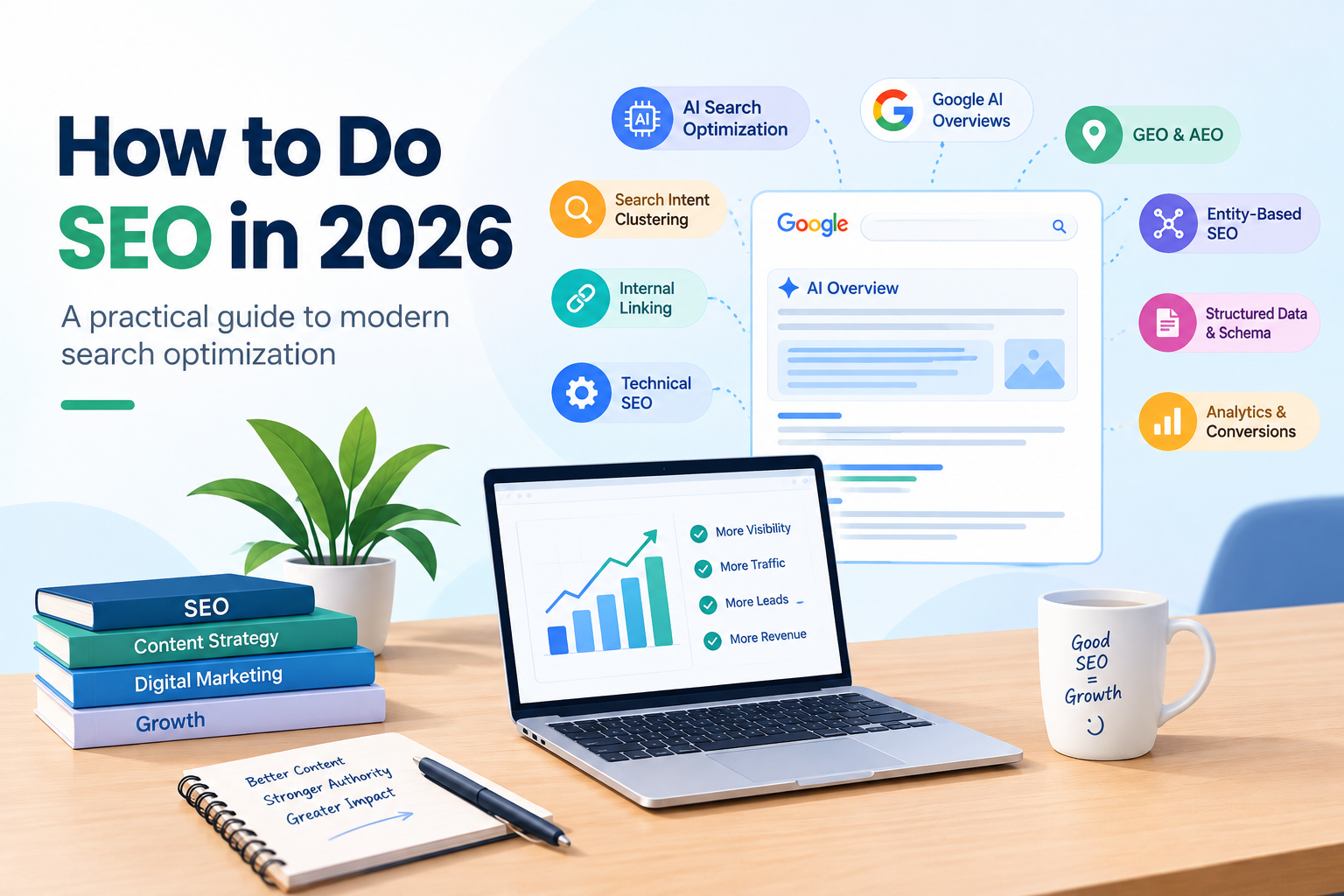
How to Do SEO in 2026: A Practical Guide to Modern Search Optimization
SEO in 2026 looks very different from the old “pick a keyword, write 1,500 words, add it to the title, and wait for Google” formula.
Search has become more conversational, visual, personalized, and increasingly AI-driven. Google Search now includes experiences such as Google AI Overviews and AI Mode, while people are also discovering information through ChatGPT, social platforms, YouTube, Reddit, images, and other channels.
That does not mean traditional SEO is dead. In fact, Google’s current guidance makes an important point: the fundamentals of SEO still matter for visibility in generative AI search features. What is changing is the way those fundamentals need to work together.
The real goal in 2026 is no longer simply to rank for a keyword. It is to become a useful, credible, recognizable source that search engines and AI systems can understand, extract information from, and confidently reference.
So, how do you actually do SEO in 2026?
1. Build SEO Around Search Intent, Entities, and Topical Authority
The biggest mistake many websites still make is treating SEO as a keyword-placement exercise.
Instead of asking, “How many times should I use my target keyword?”, start by asking:
What does the person actually want to accomplish?
Someone searching for “SEO tools” could be researching options. Someone searching for “best SEO tools for small business” is comparing solutions. Someone searching for “Semrush pricing” is much closer to making a purchase.
This is where Search Intent Clustering becomes useful.
Rather than creating one article for every slight keyword variation, group related searches according to the problem they solve. For example, a website targeting SEO beginners could create a central guide around SEO and supporting content covering keyword research, technical SEO, content optimization, link building, Google Search Console, and AI search.
These interconnected pages create Topic Clusters and help establish Topical Authority.
Think beyond keywords
Modern search engines don’t just look at individual words. They try to understand concepts and relationships between them.
That is the foundation of Semantic SEO and Entity-Based SEO.
For example, an article about “digital marketing” naturally connects to entities such as:
- Search engine optimization
- Google Search
- Content marketing
- Social media
- Paid advertising
- Conversion rates
- Search intent
- Analytics
Those relationships provide context.
This is also why Entity Optimization matters. Your brand, authors, products, people, organizations, and topics should be clearly represented across your website. Consistent information helps search systems understand who you are and what your site is actually about.
A strong content structure should therefore connect related concepts through meaningful Entity Relationships, rather than producing dozens of disconnected articles.
Make your content easy to understand and extract
AI-powered search systems need to identify useful information quickly. That makes Content Extractability increasingly important.
Don’t bury the answer underneath five paragraphs of filler.
If you’re answering “How long does SEO take?”, give a clear answer near the beginning, then explain the variables in detail.
Use:
- Descriptive headings
- Short paragraphs
- Lists where appropriate
- Clear definitions
- Specific examples
- Supporting evidence
- Direct answers to common questions
This improves Contextual Clarity for both readers and machines.
Most importantly, create information worth extracting in the first place. Original Content Creation, firsthand experience, proprietary research, examples, case studies, and expert opinions are much harder to replace with generic AI-generated summaries.
That connects directly to E-E-A-T — Experience, Expertise, Authoritativeness, and Trustworthiness. Your content should demonstrate why the reader should believe you, not merely repeat information already available on hundreds of other websites.
2. Optimize for AI Search, Not Just Traditional Google Rankings
This is probably the biggest shift in SEO in 2026.
Search engines are increasingly generating answers instead of simply displaying ten blue links. Google has expanded documentation around its generative AI search experiences, including guidance for website owners.
This has created several overlapping disciplines: AI Search Optimization, Generative Engine Optimization (GEO), and Answer Engine Optimization (AEO).
Although these terms are sometimes used interchangeably, the underlying objective is straightforward:
Make your content easy for search and AI systems to understand, trust, and reference.
Google AI Overviews and AI-generated answers
Imagine someone searches:
“How should a small business do SEO in 2026?”
Instead of clicking through several websites, they might first see an AI-Generated Search Answer summarizing the topic and linking to supporting sources.
That changes the definition of visibility.
You may receive visibility without receiving a traditional click. This is part of the broader Zero-Click Search trend.
For businesses, this means tracking more than rankings and organic sessions. You also need to think about Brand Visibility in AI Search.
Is your company mentioned when people ask relevant questions?
Does AI associate your brand with the correct topic?
Are your pages being cited?
Are competitors appearing while you remain invisible?
These questions are becoming increasingly important.
GEO and AEO: focus on being useful, not gaming the system
Generative Engine Optimization (GEO) focuses on improving the likelihood that your content is understood and surfaced within generative search experiences.
Answer Engine Optimization (AEO) focuses more specifically on providing clear answers that can satisfy question-based searches and answer engines.
But don’t interpret either as a collection of secret tricks.
Google’s current guidance specifically emphasizes that existing SEO best practices continue to matter for generative AI features.
In practice, that means:
- Create genuinely useful content.
- Answer questions clearly.
- Demonstrate first-hand experience.
- Keep information accurate and current.
- Build recognizable topical expertise.
- Make pages technically accessible.
- Support claims with credible sources.
- Avoid mass-producing low-value content.
Measure LLM visibility
Traditional SEO measurement usually revolves around impressions, clicks, rankings, conversions, and organic revenue.
With AI search, marketers also need to consider LLM Visibility and AI Citation Frequency.
For example, you might periodically test important customer questions across relevant AI search platforms and record:
- Whether your brand appears
- Whether your content is cited
- Which pages are referenced
- Which competitors appear
- How accurately your brand is represented
This data can become another layer of SEO Performance Measurement.
And remember: appearing in an AI answer isn’t the same as generating business results. The ultimate goal remains Qualified Leads & Conversions, customer growth, and Organic Revenue.
3. Strengthen the Technical Foundation Behind Your Content
You can publish the best article on the internet, but if search engines cannot properly access or understand your website, you’re creating an unnecessary obstacle.
This is where Technical SEO comes in.
Start with the basics.
Check crawlability and indexing
Your important pages need to be accessible to search engine crawlers.
Review:
- Robots.txt
- XML sitemaps
- Noindex directives
- Redirects
- Broken links
- Canonicalization
- JavaScript rendering
- Duplicate pages
- Orphan pages
Crawlability determines whether search engines can access your content.
Crawl Budget becomes particularly relevant for large websites with thousands or millions of URLs. You don’t want crawlers wasting resources on unnecessary parameters, duplicate pages, internal search results, or low-value URLs.
Then there’s Indexing Controls.
Not every page on your website needs to appear in Google. Thin internal pages, duplicate URLs, administrative pages, and certain filtered versions may need appropriate controls.
Use canonical tags correctly
Canonical Tags help communicate which URL should be treated as the preferred version when similar or duplicate pages exist.
This becomes particularly important for e-commerce websites, websites with URL parameters, syndicated content, and large content libraries.
Technical SEO isn’t glamorous, but it prevents frustrating situations where you have excellent content that simply isn’t being processed the way you expect.
Don’t ignore performance
User experience still matters.
Pay attention to Core Web Vitals, page responsiveness, loading performance, visual stability, and Mobile-First Performance.
Most importantly, don’t optimize performance simply because “Google likes fast websites.”
Optimize it because your visitors do.
A slow product page can lose a potential customer. A difficult mobile experience can destroy conversions. A confusing checkout can undo months of organic traffic growth.
SEO works best when search visibility and Search Experience Optimization work together.
Improve information architecture
Your website should make sense to both humans and search engines.
A strong Information Architecture might look something like:
Homepage → Category → Topic → Supporting Article → Product/Service
Use relevant Internal Linking to connect related pages.
For example, an article about technical SEO could naturally link to guides about crawlability, indexing, canonical tags, structured data, and Core Web Vitals.
This creates logical relationships between pages and makes it easier for visitors to continue exploring.
4. Create Content That AI Cannot Easily Replace
One of the biggest SEO problems in 2026 is not a lack of content.
It is too much mediocre content.
AI has made it incredibly easy to generate another “10 SEO Tips for Beginners” article. The problem is that search engines don’t need thousands of slightly different versions of the same generic advice.
Your competitive advantage is therefore becoming more human, not less.
Use AI as an assistant, not the author
An effective AI-Assisted Content Workflow might look like this:
Research → AI-assisted ideation → Expert validation → First-hand insights → Human editing → Optimization → Publishing → Performance analysis
This is where Human-in-the-Loop SEO becomes valuable.
AI can help you:
- Find content gaps
- Organize research
- Generate outlines
- Analyze large datasets
- Identify related questions
- Repurpose existing material
- Brainstorm headlines
- Detect content overlap
But humans should remain responsible for expertise, judgment, fact-checking, positioning, examples, and the final editorial voice.
Use AI Content Optimization to make content clearer and more useful—not simply longer.
Consolidate and prune weak content
More URLs do not automatically mean more organic traffic.
Sometimes the smartest SEO move is deleting, redirecting, updating, or combining pages.
Content Consolidation can merge several weak articles targeting overlapping intent into one genuinely comprehensive resource.
Content Pruning can remove outdated or irrelevant pages that no longer serve users or your business.
For example, imagine you have five articles:
- Best SEO Tools
- Top SEO Tools
- SEO Tools for Beginners
- Free SEO Tools
- Best SEO Software
If they all target nearly identical intent and provide little unique value, creating even more versions isn’t necessarily the answer.
Analyze performance, intent, overlap, backlinks, conversions, and usefulness before deciding whether to update, merge, redirect, or remove them.
Build original authority
This is where Thought Leadership Content, Digital PR & Earned Media, and original research can give a brand a meaningful advantage.
Publish:
- Original studies
- Industry surveys
- Expert interviews
- First-hand case studies
- Unique datasets
- Experiments
- Strong opinions supported by evidence
- Detailed customer stories
These assets can earn mentions and links while strengthening your overall authority.
The result isn’t just rankings.
It can contribute to stronger Branded Search Growth, more direct traffic, greater trust, and eventually more qualified customers.
5. Expand Beyond Google: Search Everywhere Optimization
People don’t search only on Google anymore.
They search on YouTube.
They search on Instagram and TikTok.
They search on Reddit.
They use ChatGPT and other AI systems.
They use Google Images, Maps, marketplaces, forums, and social platforms.
This is why Search Everywhere Optimization is becoming a useful way to think about modern SEO.
The goal is Multichannel Search Visibility.
Your audience might discover your brand through a Google result, watch your YouTube video, encounter your Instagram content, see a Reddit discussion, and eventually search your brand name before making a purchase.
Each interaction contributes to the customer’s decision.
Don’t treat every channel separately
Suppose you publish a comprehensive article about “SEO for small businesses.”
You could turn the research into:
- A YouTube explainer
- Short-form videos
- LinkedIn posts
- Instagram carousels
- A newsletter
- A downloadable checklist
- Original graphics
- Podcast talking points
This is not simply content repurposing.
It creates multiple opportunities for people to encounter the same expertise in the places where they already spend time.
It also supports Multimodal Search.
Search is increasingly capable of working across text, images, video, and conversational inputs. Your optimization strategy should therefore consider more than written webpages.
For example, optimize meaningful image filenames and alt text, create useful video titles and descriptions, provide transcripts where appropriate, and make visual content genuinely informative.
Don’t forget structured data
Structured Data & Schema Markup can help search engines understand specific types of content and entities on your pages.
Google explains that structured data provides standardized information about a page and can help its systems understand content and potentially display eligible search enhancements.
Depending on your website, this could include relevant schema for:
- Articles
- Products
- Organizations
- Local businesses
- Profiles
- Breadcrumbs
- Events
But schema isn’t a magic ranking button.
Its value comes from accurately describing information already present on the page and helping search systems interpret it correctly.
Conclusion: How to Do SEO in 2026
The biggest change in SEO isn’t that Google suddenly stopped caring about keywords.
It’s that search has become much better at understanding meaning, context, entities, intent, experience, and relationships.
Successful SEO in 2026 therefore combines several disciplines:
AI Search Optimization + Semantic SEO + Technical SEO + Original Content + E-E-A-T + Search Intent + Brand Building.
You need technically accessible pages, clear information architecture, strong internal linking, structured data, useful content, recognizable expertise, and a strategy for AI-powered search experiences.
At the same time, don’t become obsessed with chasing every new acronym.
GEO, AEO, LLM Visibility, AI citations, and AI Overviews matter—but the fundamentals still matter too.
Create something genuinely useful.
Make it easy to understand.
Make it technically accessible.
Show real expertise.
Connect related topics.
Build your brand beyond one search engine.
And measure what ultimately matters: qualified leads, conversions, customers, and organic revenue.
That is the real future of SEO—not writing for an algorithm, but becoming the source that algorithms, search engines, and humans have a reason to trust.